
While the term “smart glasses” has many different meanings for different people, augmented reality (AR) is the most promising use. The market for glasses that project information onto your eyes while allowing you to view your surroundings has been growing gradually, with smaller, more understated models offering sharper, more vibrant images. These glasses are incredibly helpful.
1. XReal Air 2 Ultra
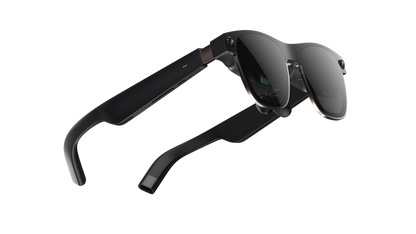
The XReal Air 2 impressed us as “bright, sharp AR glasses,” and the Air 2 Ultra is ready to surpass that rating even further. Additional movement sensors on the Air 2 Ultra include an outward-facing camera that allows for hand-tracking to operate apps and the use of AR anchors, which are printed patterns that you can place in real-world locations to define the location of projected images and even activate physical controls like switches and dials.
Not to mention, with a 52-degree field of view, these AR glasses provide some of the most visually stunning images in the category to yet. However, it still requires a connection to a device, such as a phone, and additional programs will be required in order to utilize the camera.Some are reportedly on the way, according to XReal, and the glasses will let developers experiment with the technology. For $699, you can preorder the Air 2 Ultra, which will delivery by the end of March.
2. MindLink Air
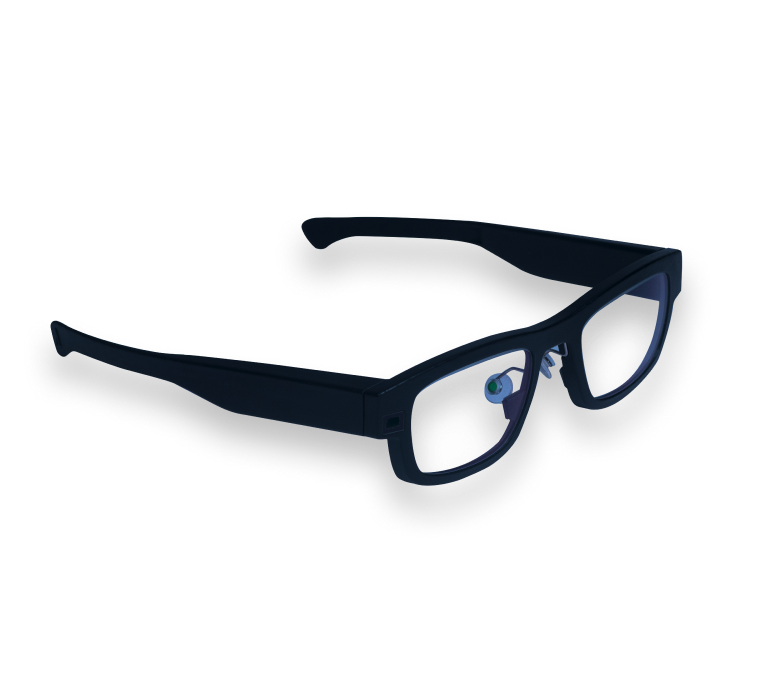
Though AdHawk, an Ontario startup, calls the MindLink Air “a fitness tracker for the brain,” its primary purpose is health-related, but it has the potential to completely transform hands-free controls for a wide range of devices. While eye-tracking devices such as the Meta Quest Pro and PlayStation VR2 analyze eye movements with cameras, the MindLink Air employs a smaller sensor system that uses MEMS (micro-electrical mechanical sensors) and infrared sensors to continuously scan the eye without analyzing visual information. As a result, the MindLink Air might appear and feel more like a regular pair of glasses than a large headset.
In the end, AdHawk wants the MindLink Air to be a wellness tool that monitors eye movements to gauge concentration levels and spot signs of stress or exhaustion. After that, it might help you develop healthier routines and lessen eye strain. While all of these objectives are commendable, our primary focus is on how technology might advance eye-tracking control systems—that is, the ability to manipulate content on those panels with a simple eye movement. According to AdHawk, glasses should start delivering in the second half of 2024.
3. RayNeo X2 Lite

RayNeo’s range of stand-alone AR glasses, the X2, run on an entirely independent mobile platform that the business developed and is based on Android 12. This implies that you won’t need to plug the glasses into a phone or other device in order to utilize them alone. Although RayNeo has been selling the X2 in China since last year, the device will be made available in the US early this year through a crowdfunding campaign.
The much superior X2 Lite, which will probably see a non-crowdfunding retail attempt in the latter half of the year, is what this X2 release is only a lead-in to. Thanks to the adoption of Qualcomm’s more recent AR1 chipset rather than its more VR-focused XR2 processor, the X2 is now sleeker and lighter than its predecessor—just over half as heavy at 60 grams as opposed to over 100 grams—while maintaining all of the same functionality.
4. EverySight Maverick

Less can look more visually. Sometimes all you need is an arrow pointing in the direction you want to go—a large map in front of you won’t suffice. The micro-OLED projectors on the EverySight Maverick have a maximum resolution of VGA (640 by 480), which is sufficient to display text messages, fitness metrics, and instructions. With the ability to project images onto the visor (the outward-facing lenses; additional prescription lens inserts are optional), the glasses manage to weigh only 47 grams and have a battery life of up to eight hours.
They employ a range of sensors to provide line-of-sight monitoring and provide location-based information and directions without the need for cameras by connecting to your phone via Bluetooth. For $399, a developer edition is currently available.
5. Spacetop

Spacetop isn’t technically a pair of smart glasses. Rather, it’s a computer that pairs with smart glasses; for the initial iteration we tested at CES, this meant wearing XReal Light AR glasses that were always connected to the system. Although Spacetop resembles a keyboard with a built-in webcam and glasses holder, those features combine to provide a full AR workplace.
Your head motions are tracked by the camera, which allows the Android-based computer to position virtual screens around you in relation to the keyboard. It offers a complete workstation that is visible just to you in an easily transportable compact. Even though it costs $2,150 for an Android system with $380 worth of AR glasses soldered on it, it’s still a great idea.