
The tech industry is expected to have a difficult year in 2024 due to the ongoing layoff of over 32,000 workers. Employers who are undergoing restructuring include Google, Microsoft, Meta, and other companies.The end of 2022 was brutal, and the start of 2023 was even more so. The global economy was shaken by widespread layoffs in a number of industries, especially the tech sector. Anxieties increased globally as a result of declining revenue, job uncertainty, and increased stress. But it doesn’t seem like this fear will go away anytime soon. Notwithstanding the fact that 2024 has arrived, the practice of layoffs has not stopped.
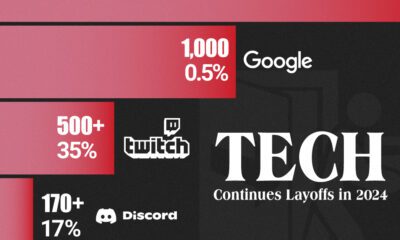
For tech companies, 2024 got off to a terrible start. Data from the website layoffs.fyi shows that in January 2024, 115 technology companies worldwide eliminated over 30,000 jobs. Among the biggest names in technology are Microsoft, Google, and a few others. These ten businesses allegedly laid off over 1,000 workers in January 2024.
According to Crunchbase, tech layoffs in 2024 have been particularly severe, with over 153,000 US workers let go so far. Compare this to 93,000 tech layoffs in 2022 as a whole. The present state of the economy, overhiring during COVID, and the development of AI are among the causes of the layoffs. In contrast to the beginning of the year, there has been a slight slowdown in the number of jobs lost.While some businesses have placed the blame on financial difficulties, others have said that artificial intelligence (AI) is beginning to replace workers. This is a trend that is expected to gain traction as tools like ChatGPT and Bard become more and more popular.
In actuality, there were more layoffs in January, which suggests that widespread layoffs may be in the works for the upcoming months of 2024. According to a recent report by Bloomberg, which was cited by Layoffs.fyi, 32,000 tech workers have lost their jobs in 2024 thus far. This comes after leading tech firms and startups, like Google, Amazon, Meta, and others, recently announced layoffs as part of reorganisation and cost-cutting initiatives.
The parent company of Snapchat, Snap, has joined the list. On Monday, it revealed that it would be reducing its global headcount by 10%, affecting 540 employees across various departments. Prior to the pandemic, e-commerce giant eBay declared that it would be laying off a thousand workers due to a surge in hiring. The tech behemoths like Amazon, Microsoft, Salesforce, Google, and others are included in this list.
The founder of Layoffs.fyi, Roger Lee, claims that the “interest rate hike” in recent months and the over-hiring following the pandemic are two of the main factors forcing even large corporations to make difficult decisions. “Tech companies are still trying to correct for their over-hiring during the pandemic surge, given that the high interest-rate environment and tech downturn have both lasted longer than initially expected,” his email stated. “Compared to last year, layoffs this year are usually more focused and smaller in nature.”
The race of artificial intelligence is another major factor in the layoffs. Lee points out that businesses such as Microsoft, Google, and OpenAI are vying with one another for the lead in artificial intelligence and are reallocating resources to concentrate on AI talent. An analysis conducted by CompTIA recently revealed that “jobs involving artificial intelligence or requiring AI skills increased by about 2,000 from December to January, to 17,479.”
Despite this development, more people are being hired in the tech sector despite the fact that tech companies are restructuring and firing employees to refocus. This is because of advancements in AI. More and more qualified workers with experience in AI and machine learning are apparently being hired by the companies. According to CompTIA, there were 33,727 active job postings in the relevant field in January alone. This is reported to be the biggest increase in a year over month.
The majority of in-demand AI-related jobs are reportedly available for the following positions: machine learning software engineer, robotics algorithms engineer, generative AI quality engineer, AI data scientist, machine learning engineer, senior applied scientist, software development engineer, AI technical solutions lead, and others.