
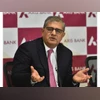
The lender’s Group Executive, Arjun Chowdhry, stated that discussions with Paytm are ongoing, but they are limited to the bank’s “general business and not any specific business.”Amitabh Chaudhry, MD and CEO of Axis Bank, referred to Paytm as a “important player” on Monday and emphasised that the private lender is open to collaborating with the fintech giant based in Noida.
According to Moneycontrol, Chaudhry said this during the introduction of Axis Bank’s “2023 Burungdy Private Hurun India 500.” However, Arjun Chowdhry, Group Executive, Axis Bank, stated during the same event that although talks with Paytm are ongoing, they are for “general business and not specific to any business.”
Subject to Reserve Bank of India (RBI) approval, Axis Bank has stated that it is willing to collaborate with Paytm.The remarks were apparently made at an event by Axis Bank’s Managing Director and CEO, Amitabh Chaudhry.Chaudhry emphasised the significance of Paytm in the market by pointing out that its well-known UPI platform facilitates the majority of its transactions, or roughly 75% of the gross merchandise value.
In response to PPBL’s “persistent non-compliances,” the Reserve Bank of India (RBI) launched a crackdown on the banking division of Paytm, Paytm Payments Bank Limited (PPBL). One of the measures is that no new deposits or credit transactions can be made after February 29.
“Subject to regulatory approval and if the regulator allows us to work with Paytm, of course we will work with them, they are an important player,” he said.Since the RBI’s attack on Paytm Payments Bank, One 97 Communications Limited, the parent company of Paytm, has no official relationships with commercial banks for its UPI app.Prior to January 31, talks between Axis Bank and Paytm were in progress, according to Arjun Chowdhry, Group Executive of Axis Bank’s Affluent Banking, NRI, Cards, and Payments.He did, however, make it clear that these conversations are unrelated to any particular transactions and are instead about general business issues.
Two Ministers of State for Finance, Pankaj Chaudhary and Bhagwat Kishanrao Karad, as well as other senior ministry officials, such as Finance Secretary T V Somanathan and Financial Services Secretary Vivek Joshi, accompanied the Union Finance Minister.The Board also discussed the state and prospects of the national and international economies, taking into account the difficulties brought on by geopolitical developments and the volatility of the world financial markets.The meeting was attended by other Central Board Directors Satish K. Marathe, S. Gurumurthy, Revathy Iyer, Sachin Chaturvedi, Venu Srinivasan, Pankaj Ramanbhai Patel, and Ravindra H. Dholakia in addition to Deputy Governors Michael Debabrata Patra, M. Rajeshwar Rao, T. Rabi Sankar, and Swaminathan J.
)
Separately, Manju Agarwal, an independent director of Paytm Payments Bank, submitted her resignation from the board on February 1st, according to a statement released by One97 Communications, the parent company of Paytm, to the exchanges on Monday. The board noticed it on February 6 and stated that it was because of her personal obligations. On February 9, One97 Communications announced the creation of a group advisory committee, which will be led by M Damodaran, a former chairman of the Securities and Exchange Board of India (Sebi).
The third iteration of the list of the 500 most valuable companies in India, “2023 Burgundy Private Hurun India 500,” was unveiled on Monday by Hurun India and Burgundy.The businesses on the list contributed 28% of India’s GDP and, taken as a whole, generated value for their stakeholders of Rs 231 trillion. It exceeds the GDPs of Singapore, Switzerland, and Saudi Arabia put together.
“We are in talks with Paytm regarding our regular business services. We’re talking about new things now that the events of January 31 have occurred,” Chowdhry stated in a TV channel interview.The Paytm regulatory landscape is getting more and more restrictive.The fintech startup founded by Vijay Shekhar Sharma’s other company, Paytm Payments Bank Ltd., has been impacted in the short and long term by the RBI’s recent directive to cease accepting deposits into its digital wallets or accounts after February 29.